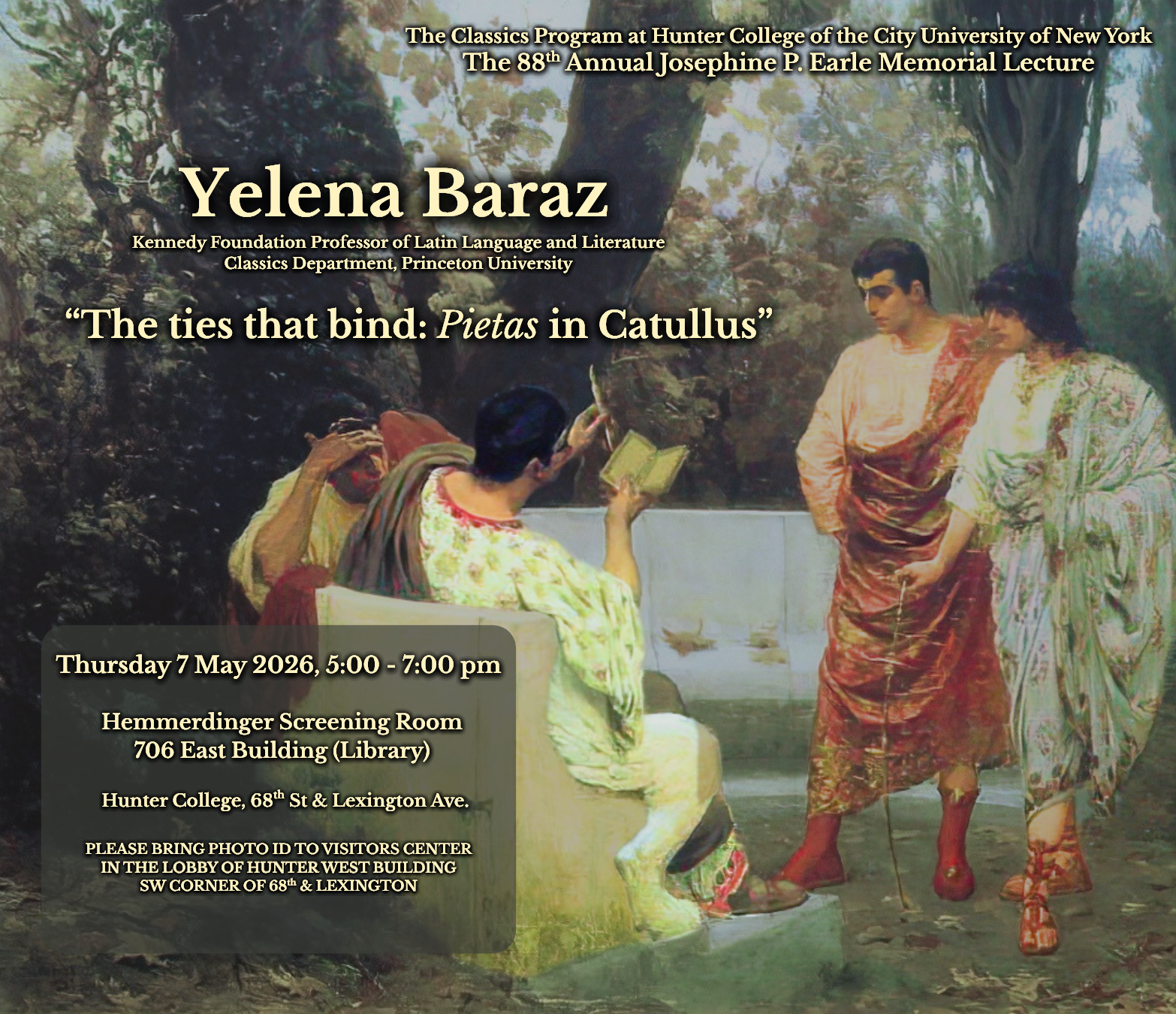
The 88th annual Josephine P. Earle Memorial Lecture at Hunter College
May
7
5:00 PM17:00

The 88th annual Josephine P. Earle Memorial Lecture at Hunter College

"The ties that bind: Pietas in Catullus"

Yelena Baraz 
Kennedy Foundation Professor of Latin
Language and Literature, Princeton University


Thursday, May 7th, 5:00pm-7:00pm
Hemmerdinger Screening Room 706
Hunter College (68th and Lex.), East Building


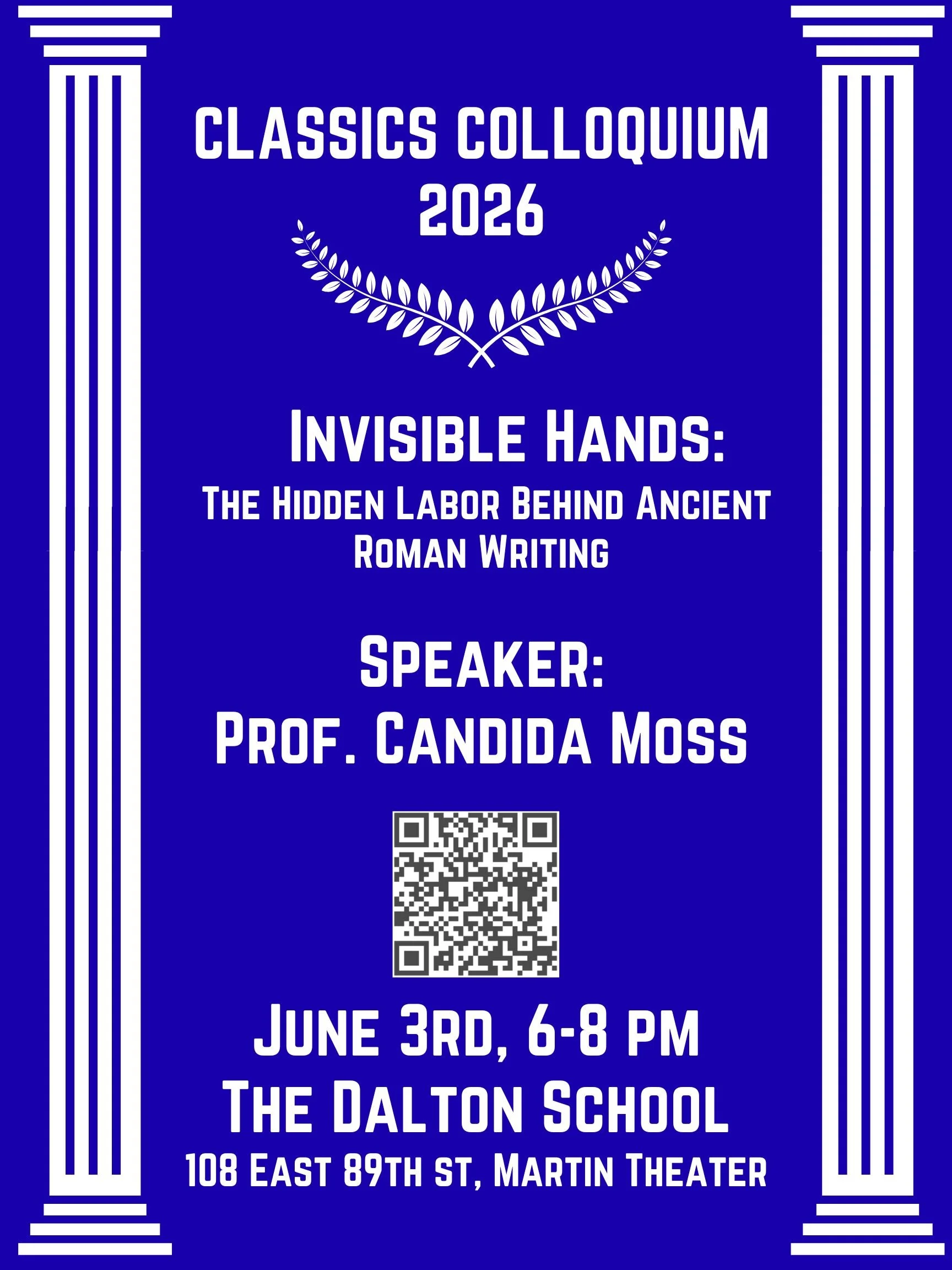
Please bring a photo ID and enter through the main lobby of Hunter West at the SW corner of 68th and Lex. See the poster below and attached for further details.


Prof. Baraz has kindly shared the following abstract:

This talk proposes a set of connections through the disparate parts of Catullus’ corpus by focusing on the role of pietas, a concept central to Roman identity, which governs relationships between family members in accordance with a divine mandate. From abuse directed at false friends, to a hoped for quasi-marriage with his beloved, to grief at the loss of his brother, pietas provides a surprising foundation for building a poetics of shared concerns.

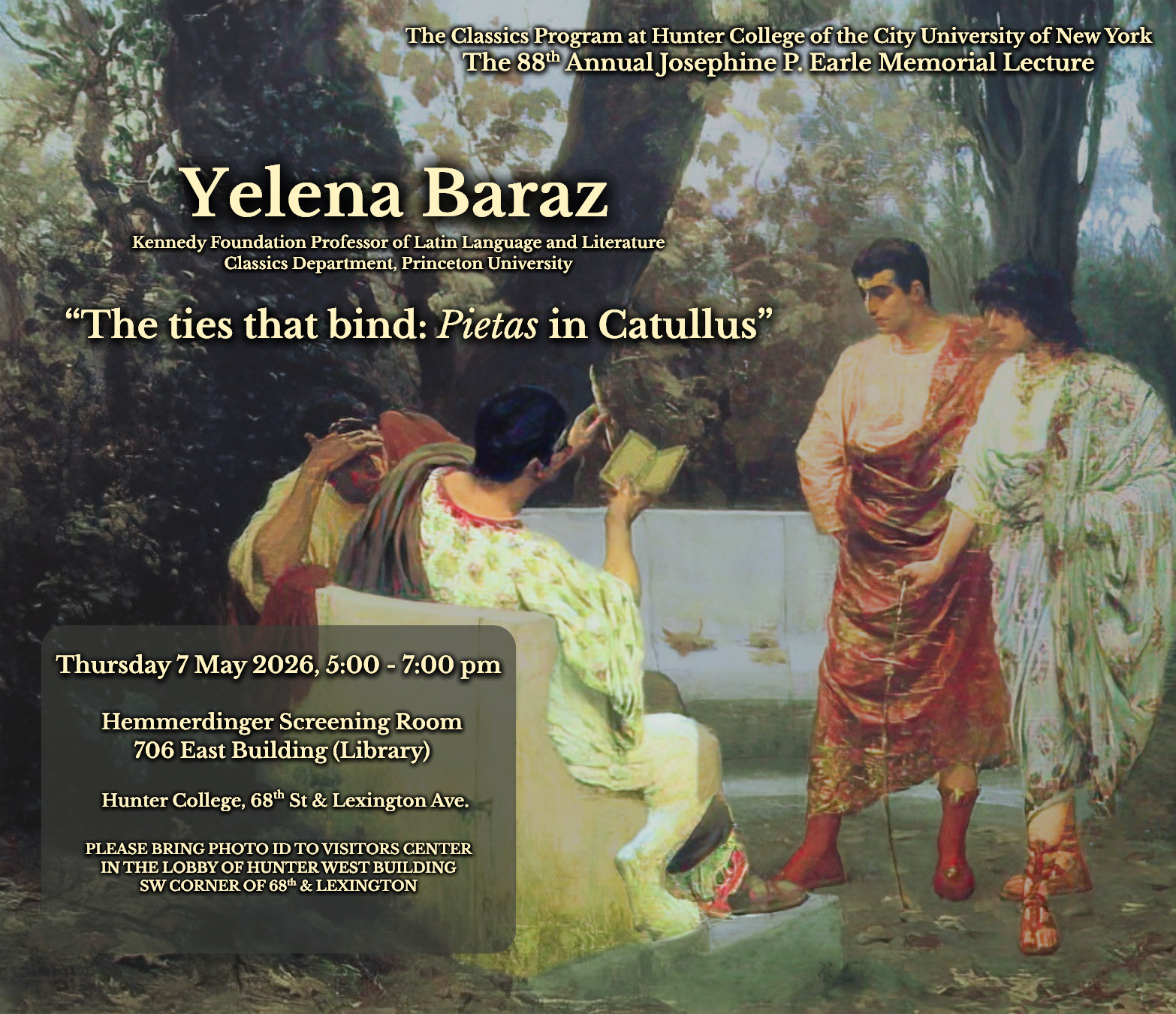
Poster shows two men sitting on stone seats, one holds a book and stylus. Two other men standing face them.

View Event →
Annual Spring Lecture 2026
May
8
4:00 PM16:00

Annual Spring Lecture 2026

The annual lecture will be given by:

Dr. Elizabeth Macaulay

The CUNY Graduate Center
Professor and Executive Officer, Liberal Studies
Professor, Anthropology, Classics, Digital Humanities, Middle Eastern Studies, Public Scholarship

Beyond the White City: Fantasy, Power and Ancient Architecture at America’s World’s Fairs, 1893–1915

Chicago’s Columbian Exposition of 1893 celebrated the quadricentennial of Columbus’s “discovery” of the Americas by creating a fantastical White City composed of Roman triumphal arches and domes, Corinthian colonnades, and Egyptian obelisks. World’s fairs were among the most important phenomena of the nineteenth and twentieth centuries: millions visited and came away understanding the modernity and progress of these cities and the nascent superpower of the United States. But what they found was often a representation of the past. Ancient Greco-Roman and Egyptian architecture was deployed to create immersive environments at fairs held in Chicago, Nashville, Omaha, St. Louis, and San Francisco between 1893 and 1915. The seemingly endless adaptations of ancient architecture at these five fairs demonstrated that ancient architecture could symbolize and transmit the complex – and often paradoxical or contradictory – ideas that defined the United States at the turn of the twentieth century and still endure today. This talk will examine how ancient architecture was a powerful means for expressing the modernity of the United States by considering specific buildings from each of these fairs.

FORTHCOMING PUBLICATION:
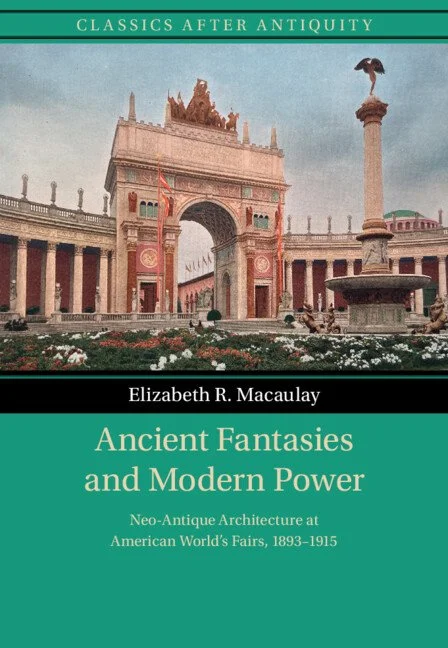
Ancient Fantasies and Modern Power
Neo-Antique Architecture at American World's Fairs, 1893–1915


Our annual Spring lecture is the time when we conclude the year with a lecture, awarding of spring contest prizes and elections for the next year.

View Event →

Apr
28
4:15 PM16:15

Columbia Classics Colloquium – Ian Moyer

  • Columbia University, 603 Hamilton Hall (map)
  • Google Calendar ICS

Speaking with Egyptian gods:
dialogue and difference

Ian Moyer
Associate Professor
University of Michigan

When Lucius, in the final book of the Metamorphoses, prays to an unknown lunar goddess and receives a reply from Isis, Apuleius has his characters, one human and one divine, address each another in Latin literary versions of Greek genres of discourse, including well-known hymns and self-revelations of Isis.  Apuleius was not simply adapting Greek texts to his literary purposes; he was also representing existing dialogical relations between a range of Greek inscriptions, and – crucially – the spoken utterances for which they stood.  Several of these inscribed discourses adopt and adapt stylistic and formal features from each other that were regarded as characteristic of Isiac genres of discourse.  Drawing on examples from the Memphite self-revelation of Isis, adaptations from Maroneia and Andros, as well as the hymns of Isidorus from Medinet Madi, this talk explores the dialogical discourse of Greek hymnic texts belonging to Isis and her circle and their literary representation by Apuleius.  While such texts have long been understood as domesticating translations of an exotic divinity intended to facilitate her assimilation into Hellenistic and Roman societies, examining them collectively and in their dialogical relations with one another shows that their discourse held a place for difference, figuring Isis as a stranger who was neither fully assimilated nor wholly other.

For a Zoom link, email Paraskevi Martzavou at pm2839@columbia.edu

PLEASE NOTE: To attend in person, non-Columbia students/staff will need to contact Columbia ahead of time to be put on a list for entry.

View Event →
Greek & Latin Recitation Contest 2026
Apr
25
2:00 PM14:00

Greek & Latin Recitation Contest 2026

  • Institute for the Study of the Ancient World (ISAW) (map)
  • Google Calendar ICS

Can you rhapsodize like Homer or orate like Cicero? Come and compete against other Greek and Latin enthusiasts and win these prizes:

Prizes for the Oral Reading of Greek: 1st: $300; 2nd: $200; 3rd: $100.

Prizes for the Oral Reading of Latin: 1st: $300; 2nd: $200; 3rd: $100.

Any college or university student is eligible to compete. Contestants may compete for both the Greek and Latin prizes, or for either one. Memorization is not required; feel free to read from a script.

Choose one of the following passages:

Greek: Plato, Symposium 189d5 (δεῖ δε ...) to 190a4 (... ἐικάσειεν) OR Euripides, Medea 230-43

Latin: Sallust, Bellum Catilinae 52.2 (l onge alia ...) to12 (... perditum eant ) OR Horace, Odes 1.9


Registration Deadline is 18 April, 2026. Please email Prof. Katharina Volk to register.

Please share our flyer.


View Event →
Undergraduate Greek and Latin Translation Contest 2026
Apr
24
1:30 PM13:30

Undergraduate Greek and Latin Translation Contest 2026

  • Fordham, Lincoln Center campus, Rm 904 (map)
  • Google Calendar ICS

The New York Classical Club undergraduate Greek and Latin translation examinations will be held Friday April 24, 2026, between 1:30pm and 5:00 p.m.at the Lincoln Center Campus of Fordham University, 113 West 60th Street, New York, NY 10023, Lowenstein Building Rm. 904. The Greek exam will be given from 1:30 to 3:00 p.m.; the Latin from 3:15 to 4:45 p.m. 

1:30-3pm: Greek exam
3:15-4:45pm: Latin exam

Each examination will consist of one prose and one poetry passage appropriate for undergraduates.  Tragedy and Attic prose are often given in the Greek exam; Cicero and Virgil are typical authors for the Latin exam.

REQUIREMENTS: A minimum of 2 years of college Greek and/or Latin (including the current semester) or the equivalent.  The awards are not restricted to Classics majors and are open to all current undergraduates whether or not they are members of the New York Classical Club. Students may compete in one or both languages, and those who have participated in the past are welcome to do so again.

APPLICATIONS:  Instructors should write a brief letter or email message nominating students and send it to me at the address below. The letter should state that the applicant is a bona-fide student this term and indicate which of the exams the student wishes to take. Students should also send a letter directly to Matthew McGowan.

DEADLINE:  All faculty nominations and student applications should be received by Wednesday April 22nd.

PRIZES:  Cash prizes of $300, $200, and $100 will be awarded to the winners in each exam.  Winners and their instructors will be notified very soon after the exam. The prizes will be awarded at the Club's spring meeting on Friday, May 8th at the CUNY Graduate Center. The Club at its discretion reserves the right to award fewer than three prizes for each examination.

  • Fordham’s Lincoln Center campus is easily reached by subway. Closest subway stops are 59th St. / Columbus Circle (1/A/B/C/D) and 57th St. & 7th Avenue (N/Q/R/W).

  • The entrance to 113 West 60th Street is on Columbus Avenue.

  • Ask the guard to direct you to the elevators on Lowenstein’s Plaza Level to reach the 9th floor and room 904.


For more information contact: Matthew McGowan
See flyer here: Undergraduate Translation Exam 2026

View Event →
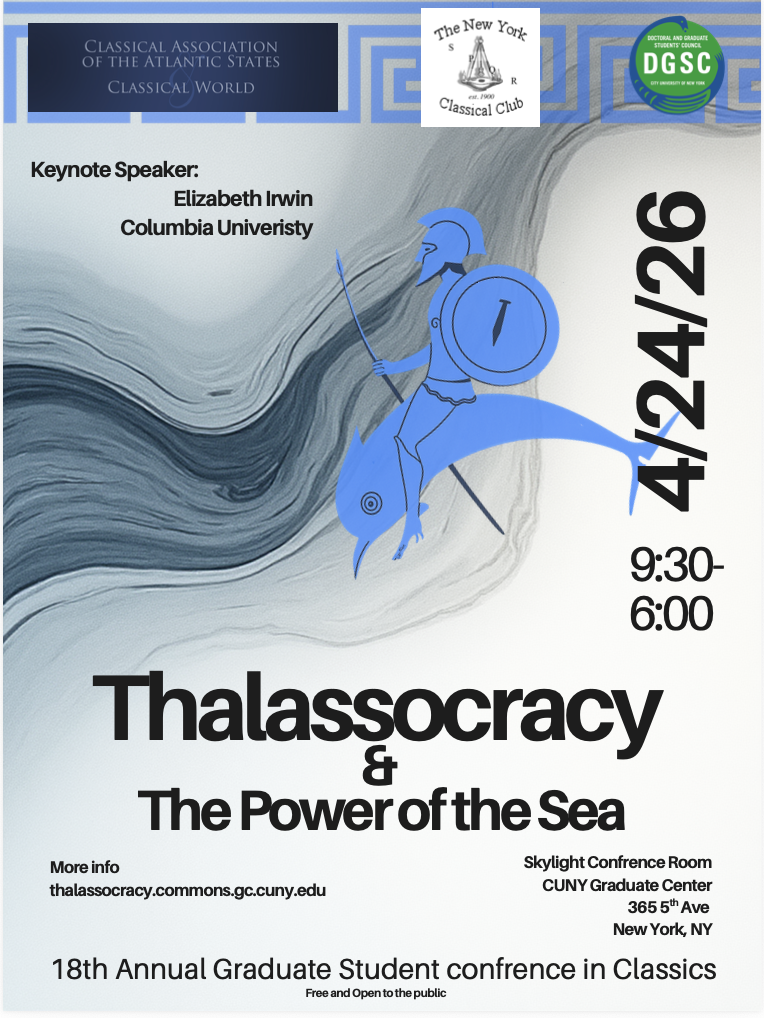
18th Annual CUNY Graduate Student Conference in Classic
Apr
24
9:30 AM09:30

18th Annual CUNY Graduate Student Conference in Classic

  • CUNY Graduate Center, Skylight Conference Room (map)
  • Google Calendar ICS

Thalassocracy and the Power of the Sea

Keynote Speaker: Elizabeth Irwin, Columbia University 

From the palaces of Knossos to the Rock of Gibraltar and beyond, the Mediterranean Sea dominated the world around it, shaping the societies that developed upon its shores. The earliest legends, the tales of the Trojan War and its aftermath, begin with a woman whose face launched a thousand ships, and end with the ten-year odyssey of a man whose story continues to resonate today, as this summer’s highly-anticipated Christopher Nolan blockbuster demonstrates. But what truly lies at the heart of the ancient sea?

Please see their website for updated information.

View Event →
High School Translation & Recitation Contest 2026
Apr
11
12:00 PM12:00

High School Translation & Recitation Contest 2026

The New York Classical Club invites you to send your students to this year’s Latin Sight Translation Contest for High School Students and to the second High School Latin Recitation/Reading Contest.

The translation contest will take place from 12:00-1:30, and the recitation/reading contest will follow from 2:00-4:00. There will be some light refreshments available from 1:30-2:00. Monetary prizes will be awarded to the top three elocutionists in prose and poetry and to the top three translators in each of the five divisions of the competition. 

The different levels for this competition are:

Caesar – Division I                   Cicero – Division II                   Ovid – Division III

Vergil – Division IV                   Horace – Division V

Please note that all divisions will have appropriate vocabulary help, which we hope will encourage students to participate.  

For the recitation/reading contest, students may choose to compete in either prose or poetry. Students may notcompete in both categories. There will be separate prizes for prose and poetry this year.  For Latin Prose, the passage is Seneca the Elder's Controversiae, 1.1-4 and, for Latin Poetry, the passage is Virgil's Aeneid, 4.305-330. Link to passages here. Please note that students are not required to memorize the passages and are able to read from a script. If you have students participating in the recitation/reading contest, we ask that you fill out this form by Friday, April 3rd.

 If you are sending students to the translation contest, please fill out this registration form by Friday, April 3rd.  We ask that you limit your registration to three students per level (thus, a maximum of 15 students per school).

If you are bringing students, please volunteer to stay and proctor one of the contests; this year's event promises to be full of memorable moments, and we would so appreciate your presence and help.

View Event →
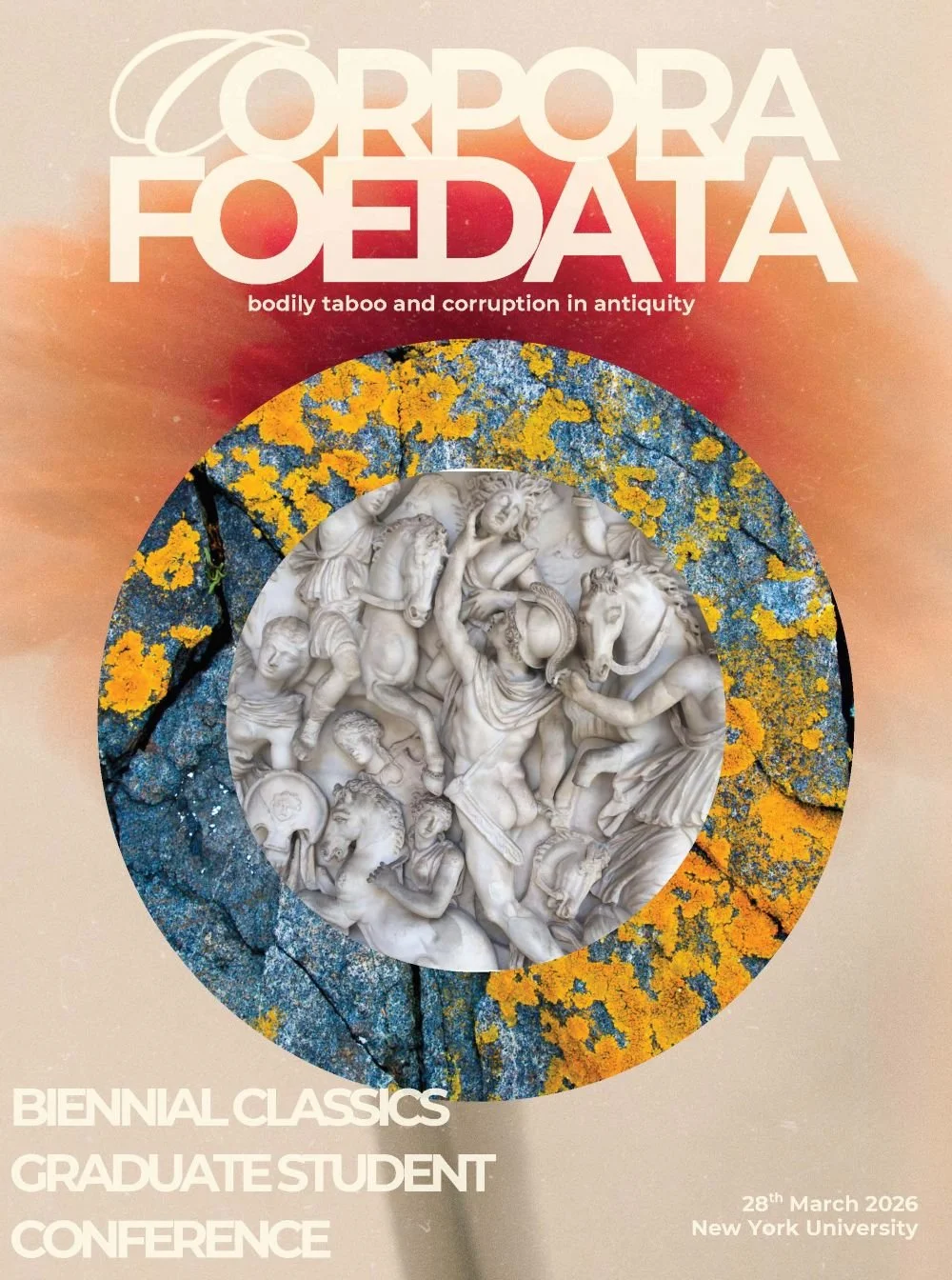
The NYU Biennial Department of Classics Graduate Student Conference (2026)
Mar
28
9:00 AM09:00

The NYU Biennial Department of Classics Graduate Student Conference (2026)

Corpora Foedata: Bodily Taboo and Corruption in Antiquity

Detailed schedule TBA. See website in the meantime.

What constituted ancient logics of corruption and pollution? Ancient medicine speaks to the curative effects of ‘purification’ (katharsis), the body’s release of corrupting pestilence or imbalance. Mindful of the history of the 20th century, which saw the application of Germ-theory to disastrous ideologies of ethnic purity, we are sensitive to thoughtscapes which relate notions of the body’s corruption to that of the community. The analogy of body to community and of community to body was, indeed, not uncommon in antiquity. What then were the notional processes by which familial, civic, religious, or ’social bodies’ became corrupted? Ancient discourses testify certain behaviors which are uniquely ‘polluting’ or ‘corrupting’: incest, cannibalism, homicide, among others. How are these violations of the flesh presented in the literary and material records? More abstractly, within the full spectrum of ancient discourse, where are the places, times, or moments where corruption and taboo are normatively defined? How, moreover, was the discourse of corruption caught between asymmetries of socio-political power and traditional modes of defining or questioning social values?

A quarter-century ago, Horden and Purcell’s Corrupting Sea provided a new ecological model of the ancient economy. The Mediterranean was a unique geography which maximized, as it were, the constant ‘corruption’ of communities through their necessitated yet ever-complicated relationship with the sea. Communities were built on exchange, meixis, the very expectation of ‘corruption,’ and indeed its need for positive integration. What therefore made sense of the world’s seemingly constant corruption of the community or perhaps of the oikoumēnē itself as a constantly self-corrupting body? We remember the descriptions of socially subversive Bacchic ritual, related to us by Euripides and Livy, but communities also institutionalized and welcomed both Dionysus and many other new gods, a complex phenomenon central to the study of religious change. Initiatory religion, through such components as aischrologia, adapted contexts for licensed obscenity, otherwise corruptive speech ritually made acceptable. We are therefore moved to juxtapose different models of transformation–personal, ritual, and communal–, their bearing on the language of ‘corruption,’ and their practiced and discursive traits.

Registration is required at the following link: https://forms.gle/mGKBLu3X9hxaz8Qr7

For more information, contact the conference organizers at: nyuclassicsgraduateconference@gmail.com

This conference is generously sponsored by the NYU Department of Classics, Center for Ancient Studies, Institute for the Study of the Ancient World, Italian Studies, Medieval and Renaissance Center, Skirball Department of Hebrew and Judaic Studies, and the New York Classical Club.

View Event →
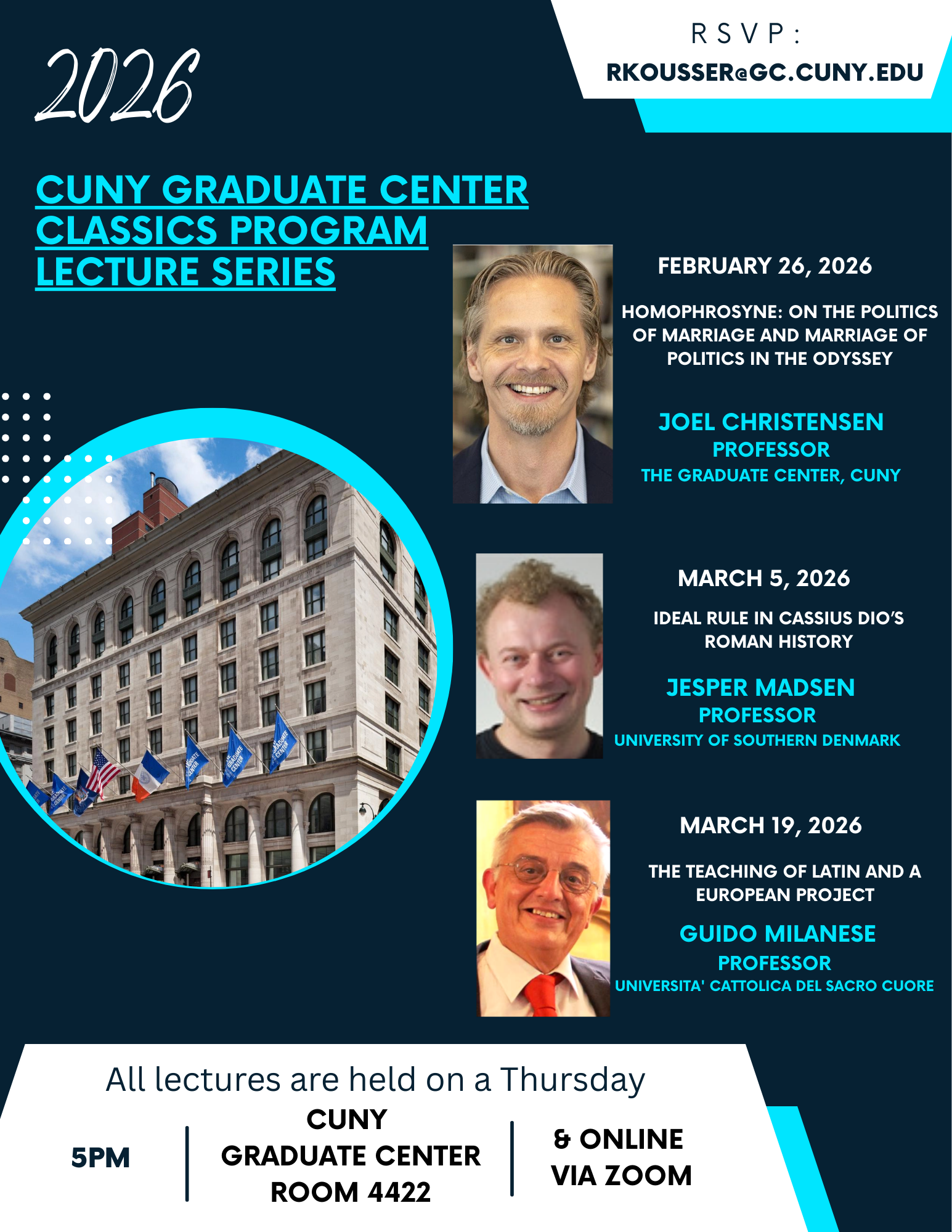
CUNY Graduate Center Spring Lecture Series
Mar
19
5:00 PM17:00

CUNY Graduate Center Spring Lecture Series

Guido Milanese
Professor of Classics
Universita' Cattolica del Sacro Cuore
Brescia-Milano IT

 The teaching of Latin and a European project

What role can Latin play in general education, i.e. in teaching that is not aimed at future specialists? At a time when there is a sort of renewed interest in Latin in Europe, an educational project involving five European countries offers an interesting perspective. For a long time, Latin was assigned metalinguistic tasks (description of morphological and syntactic linguistic functions) that are now carried out through the learning of spoken foreign languages and the teaching of linguistics. Latin now has a clear historical function, enabling a direct relationship with the texts of European culture from antiquity to the dawn of Romanticism. This gives rise to a vision of Latin teaching that is not limited to antiquity, but extends to the Medieval, Renaissance and early modern worlds. In this context, learning vocabulary and consolidating core vocabulary is central, so that texts can be read directly without immediately aiming for translation but rather for comprehension of the text through the assimilation of sufficient core vocabulary. The Eulalia -- In-Eulalia project, developed over several years in Europe, aims to achieve uniformity in Latin learning levels across the continent by proposing clear levels of linguistic competence and developing teaching tools that enable an efficient approach to the study of Latin and effective educational and cultural exchange between European nations in order to recognise themselves in the common culture that unites them.

In person at the CUNY Graduate Center, Room 4422
OR
Via Zoom— email RKousser@gc.cuny.edu for the link

View Event →
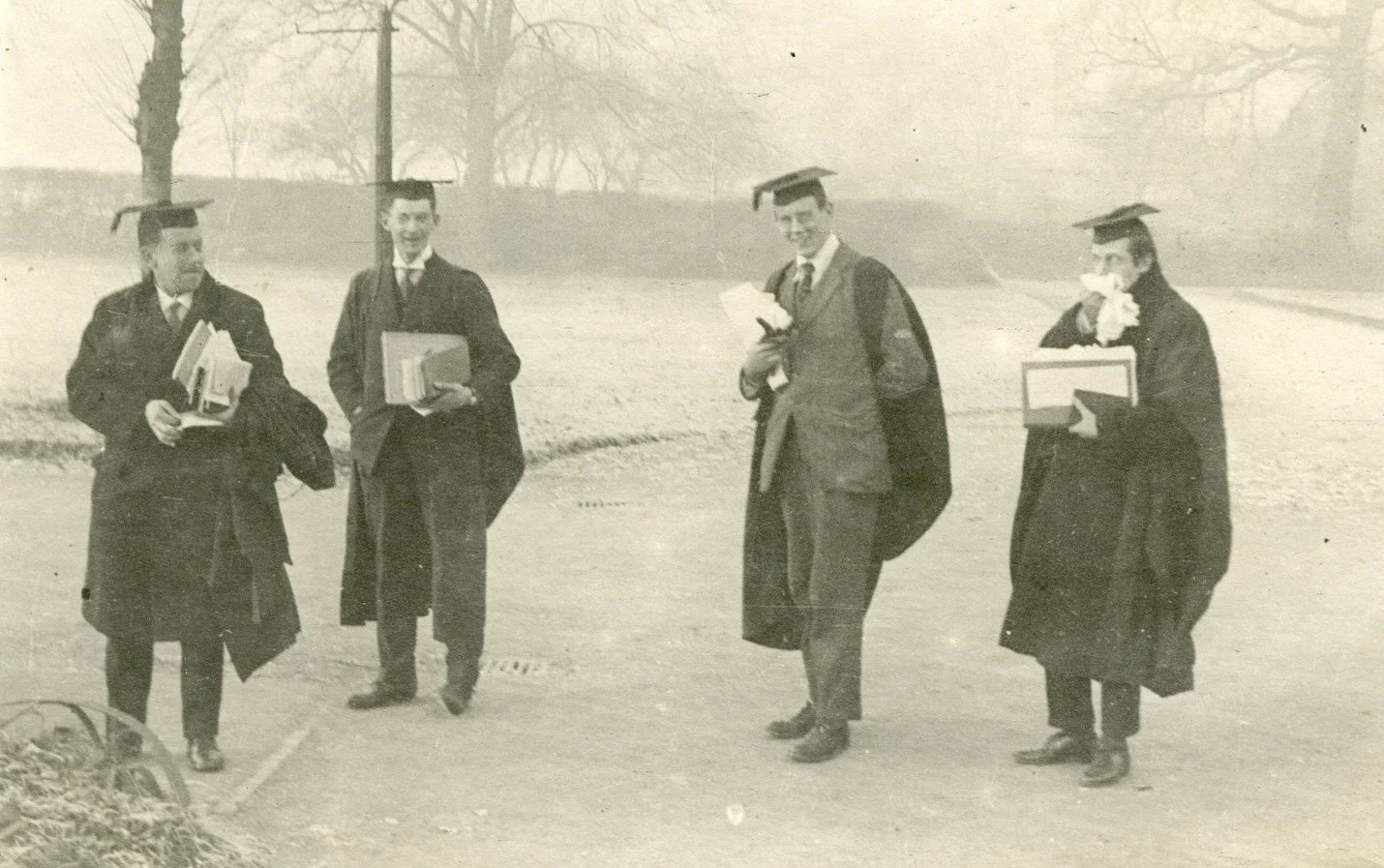
Columbia Classics Lecture: Ronald Knox, Classical Education, and World War I
Mar
6
4:10 PM16:10

Columbia Classics Lecture: Ronald Knox, Classical Education, and World War I

  • Columbia University, 603 Hamilton Hall (map)
  • Google Calendar ICS

NOTE that you will need a valid ID to enter the Columbia campus. 
If you need guest access, please email Katharina Volk at kv2018@columbia.edu.

Tom Keeline, Washington University St. Louis
"Ronald Knox, Classical Education, and World War I"


Ronald Knox (1888–1957) was one of the most brilliant of a brilliant generation of English classicists. He was also a member of the English generation that was shattered by World War I. As his friends were fighting and dying in France, Knox himself took a leave of absence from his fellowship at an empty Oxford and spent 1915–1916 teaching Classics at Shrewsbury School. In my presentation, I’ll reconstruct Knox’s revolutionary teaching at Shrewsbury and the role that Classics played in giving his life meaning and purpose during the war years. Knox’s approach to the classroom and to Classics still has much to teach us: about Edwardian classical education and classical reception, about pedagogy, and maybe even about life.

View Event →
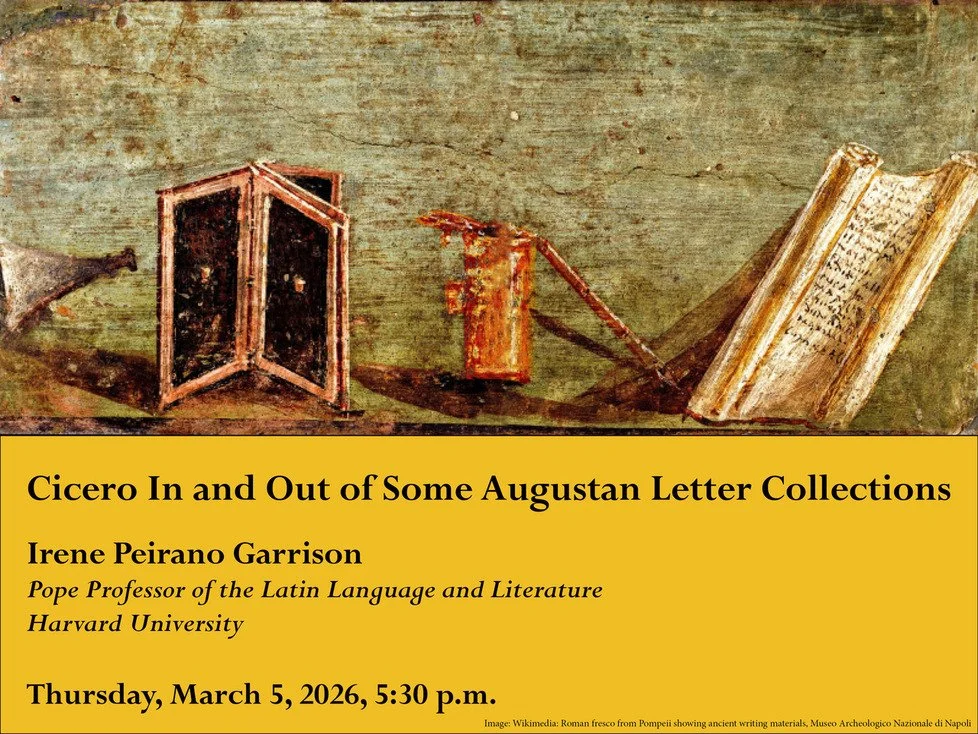
Cicero In and Out of Some Augustan Letter Collections
Mar
5
5:30 PM17:30

Cicero In and Out of Some Augustan Letter Collections

  • NYU: Jurow Hall, Silver Center for Arts & Science (map)
  • Google Calendar ICS

The NYU Department of Classics in conjunction with the Center for Ancient Studies announces

The NYU Department of Classics First Annual Raffaella Cribiore Lecture

Irene Peirano Garrison (Harvard University)

Reception to follow.

This event will take place in-person only. It is free and open to the public, but advance registration is required. A valid government-issued photo ID is required for building entry.

Jurow Hall, Silver Center for Arts & Science
31 Washington Place (accessible entrance), 1st Floor
New York, NY 10003

For more information, contact the Department of Classics at 212.998.8597 or as-classics-department@nyu.edu

View Event →
Mar
5
to Mar 6

CUNY Classics Program Lecture: Jesper Madsen

Jesper Madsen, University of Southern Denmark
Ideal Rule in Cassius Dio’s Roman History


There is a consensus in modern scholarship that Cassius Dio favoured a form of government where the senatorial class was an integrated part of both the decision-making process and the administration of the empire. In this paper, I question that assumption. Most scholars have focused on the fictitious dialogue between Augustus’ companions Agrippa and Maecenas, and the few passages where Dio compares Republican and monarchical rule. In contrast, I include Dio’s entire narrative to see how monarchical and Republican rule performed historically across the millennium the historian covers in what is left of the eighty books he composed. In the paper I offer snapshots from regal Rome, the age of the Republic, and Imperial Rome, focusing on the reign of Augustus and Dio’s own lifetime when he was a devoted member of the imperial administration. I explore whether Dio believed Republican rule was ever a reliable alternative to monarchical rule. Furthermore, I ask what in Dio’s eyes constituted the best form of monarchical rule and whether the senatorial class was ever—historically or in Dio’s own experience—a reliable social group either at the time they were ruling Rome or as partners of the emperor. Across the paper I compare Dio’s views and his approach to Roman politics with the parallel sources. 

IN PERSON: CUNY Graduate Center, Room 4422
ZOOM: email rkousser@gc.cuny.edu for the link

View Event →
Annual Fall Lecture 2025
Oct
4
3:00 PM15:00

Annual Fall Lecture 2025

  • Fordham University | Lincoln Center Campus (map)
  • Google Calendar ICS

Speaker: Dr. Samuel Holzman
Assistant Professor of Art and Archaeology
Stanley J. Seeger '52 Center for Hellenic Studies
Director, Program in Archaeology

The Colors of Ancient Greek Architecture

Color was an integral feature of ancient Greek temples. Although these hues have largely faded, ample evidence survives, from trace amounts of pigments still in situ to inscribed receipts for the workers who carried paint pots up scaffolding. This talk looks closely at the relationship between color and shadow design, focusing on how ancient architects complemented carved designs with painted details and sought to balance interiors and exteriors.

Please see (and distribute!) our flyer here.

View Event →
Annual Spring Lecture 2025
May
16
4:00 PM16:00

Annual Spring Lecture 2025

Alexander the Great:  What New Research Tells Us and Why He Still Matters

by Dr. Rachel Kousser, Professor and Executive Officer, Program in Classics, CUNY Graduate Center


Alexander the Great lived over 2,300 years ago, but he still fascinates us.   This talk examines his storied greatness, drawing on exciting new research and integrating diverse perspectives to show this  larger-than-life figure as never before.  It asks, in an age of ambitious, competitive, and brutally effective political leaders, what made him stand out?  How can we reconstruct the untold stories of the people who made him what he was?   And what makes this long-dead historical figure relevant for today’s world?  What can we learn from his “successes,” but also his failures and mistakes?  I offer a behind-the-scenes look at my research process, key discoveries, and writing journey — which, like Alexander’s, was not a heroic solo endeavor but instead a group effort, and particularly a partnership. 

Our annual Spring lecture is the time when we conclude the year with a lecture, awarding of spring contest prizes and elections for the next year.

View Event →
High School Translation & Recitation Contest 2025
Apr
26
12:00 PM12:00

High School Translation & Recitation Contest 2025

The New York Classical Club invites you to send your students to this year’s Latin Sight Translation Contest for High School Students and to the second High School Latin Recitation/Reading Contest.

This year’s competitions will be held on Saturday, April 26th from 12:00 PM - 4:00 PM at The Nightingale-Bamford School (20 East 92nd St., between Madison and 5th Ave.) in Manhattan.  The translation contest will take place from 12:00-1:30, and the recitation/reading contest will follow from 2:00-4:00. There will be some light refreshments available from 1:30-2:00. Monetary prizes will be awarded to the top three elocutionists in prose and poetry and to the top three translators in each of the five divisions of the competition. 


If you are sending students to the translation contest, please fill out this registration form by Friday, April 18th.  We ask that you limit your registration to three students per level (thus, a maximum of 15 students per school).

The different levels for this competition are:

Caesar – Division I                   Cicero – Division II                   Ovid – Division III

Vergil – Division IV                   Horace – Division V

 Please note that all divisions will have appropriate vocabulary help, which we hope will encourage students to participate.  

            For the recitation/reading contest, students may choose from the following passages, for Latin Prose, Cicero's In Catilinam 1.7 and for Latin Poetry, Ovid's Metamorphoses 3.660-689. You can find the passages for the recitation/reading contest at the end of this email.  Please note that students are not required to memorize the passages and are able to read from a script. If you have students participating in the recitation/reading contest, we ask that you fill out this form by Friday, April 18th.

If you are bringing students, please volunteer to stay and proctor one of the contests; this year's event promises to be full of memorable moments, and we would so appreciate your presence and help.

Thank you, and we look forward to seeing you and your students at the Latin Sight Translation Contest for High School Students and the inaugural High School Latin Recitation/Reading Contest on Saturday, April 13th at 12:00.

PLEASE SHARE OUR FLYER

View Event →
Latin & Greek Recitation Contest 2025
Apr
5
2:00 PM14:00

Latin & Greek Recitation Contest 2025

  • Institute for the Study of the Ancient World (ISAW) (map)
  • Google Calendar ICS

Latin & Greek Recitation Contest 2025

Can you rhapsodize like Homer or orate like Cicero? Come and compete against other Greek and Latin enthusiasts and win these prizes:

Prizes for the Oral Reading of Greek: 1st: $300; 2nd: $200; 3rd: $100.

Prizes for the Oral Reading of Latin: 1st: $300; 2nd: $200; 3rd: $100.

Any college or university student is eligible to compete. Contestants may compete for both the Greek and Latin prizes, or for either one. Memorization is not required; feel free to read from a script.

Choose one of the following passages:

Greek: Plato, Apology 41c7 (Ἀλλὰ κα]ὶ ...) to d9 (... μέμφεσθαι) OR Homer, Iliad 406-420

Latin: Cicero, First Catilinarian 32-33 OR Catullus 3.

Registration Deadline is 29 March, 2025. Please email Prof. Katharina Volk to register.

Please share our flyer.

View Event →
Student Conference
Feb
7
5:00 PM17:00

Student Conference

  • 9 West 57th Street, 46th Floor New York, NY, 10019 United States (map)
  • Google Calendar ICS

Epic Tradition with Jeffrey Ulrich (Rutgers)

The New York Classical Club is proud to present a lecture for high school students on the epic tradition, focusing on The Odyssey and The Aeneid. The speaker will be Jeffrey Ulrich, Professor of Classics at Rutgers University. Following the lecture, there will be time for Q&A with Professor Ulrich. Light refreshments will be served.

This conference is for high school students in the New York City Metro area. Please email Louis Cohen to RSVP. We want an accurate account of attendees to plan for seating and refreshments. Teachers are encouraged to attend.

Flyer

View Event →
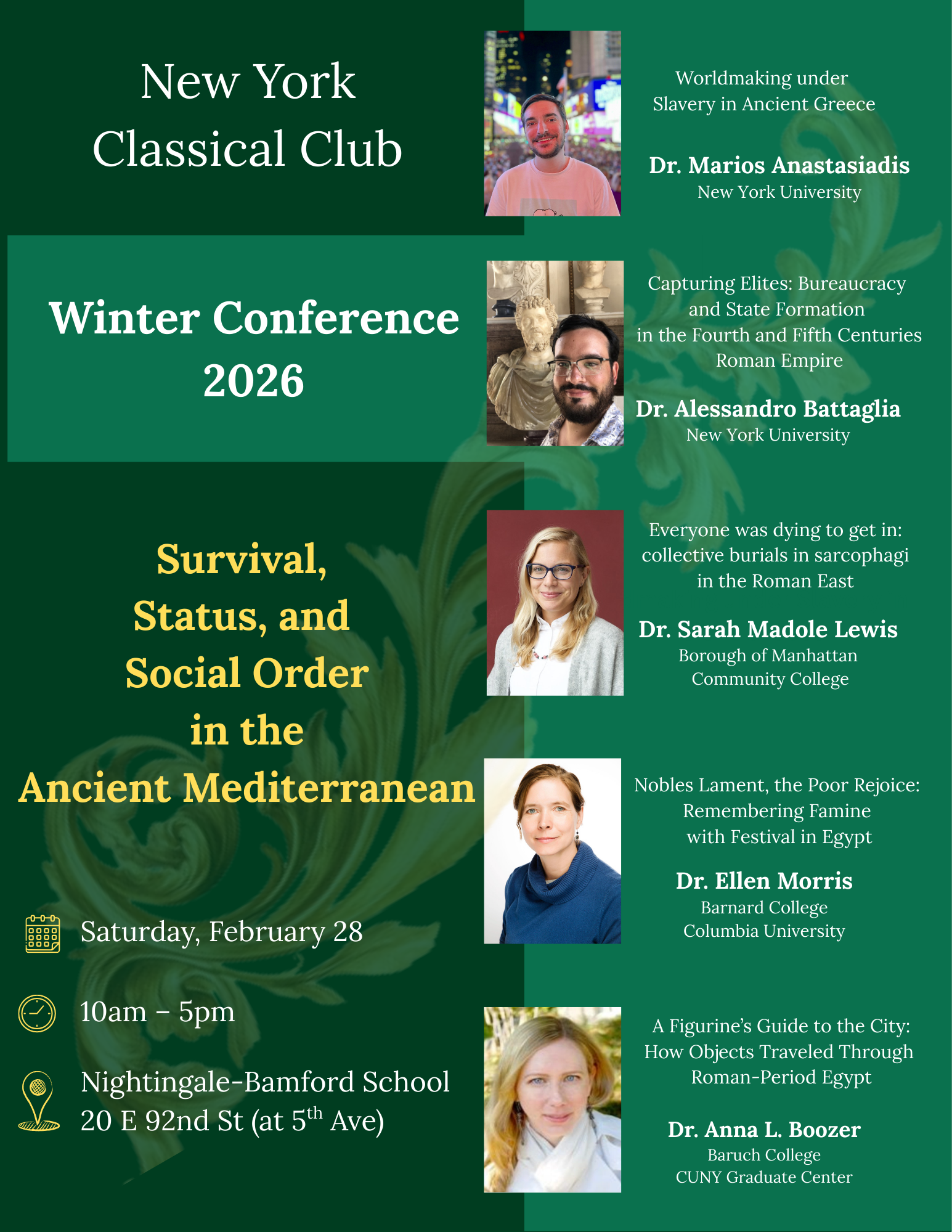
Winter Conference 2025
Feb
1
9:30 AM09:30

Winter Conference 2025

  • Jurow Hall, Silver Center (NYU) Room 101A (map)
  • Google Calendar ICS

Suscitanda: Topics in Classics

Join us for a day of learning about various Classics-related topics.

Teachers and graduate students are especially invited to attend. Persons under 18 are discouraged due to the adult content of one talk.

The following speakers will share and instruct on codicology, papyrology, numismatics, and AI in Language learning: 

  • AnneMarie Luijendijk (Princeton)

  • Patrick Burns (ISAW)

  • Susanne Hafner (Fordham)

  • Liv Yarrow (Brooklyn College)

Please come ready to do a little hands-on learning and activity. A laptop and your favorite bit of Latin text are necessary for the AI workshop. All other materials will be provided.

Light refreshments, lunch, and a reception are provided.

Lastly, we ask all attendees to register in advance. NYU Security requires a list of attendees ahead of time. Access to the conference may be restricted to those who have not registered in advance. Please share the flyer.

This event is co-sponsored by the NYU Classics Department, the NYU Center for Ancient Studies, and the Program in Classics at CUNY Grad Center.

View Event →
Roman Graffiti as evidence for crucifixion and its depiction in late antiquity
Oct
19
3:00 PM15:00

Roman Graffiti as evidence for crucifixion and its depiction in late antiquity

  • Fordham University (Lowenstein Building - South Lounge) (map)
  • Google Calendar ICS

Annual Fall Lecture 2024

Roman Graffiti as evidence for crucifixion and its depiction in late antiquity

by Dr. Felicity Harley-McGowan, Yale Divinity School

Join us for a discussion that explores Roman crucifixion and its development into religious iconography.

Crucifixion played an important role in the Roman criminal justice system, with large numbers of people executed in this way during uprisings and otherwise. Literary sources offer no clarity about how these executions were carried out, archaeological evidence is rare, and pictorial evidence almost absent. This lecture discusses one of only two images of a crucified victim to survive from the Roman world: a graffito from the 2nd century AD, excavated in Southern Italy in 1959. The image preserves important evidence both of the practice of crucifixion by the Romans in the first centuries AD and for the graduation development of an iconography of crucifixion in Roman, and subsequently Christian, art.

Light refreshments will be served. Please share the flyer.

View Event →
Annual Spring Lecture 2024
May
17
4:30 PM16:30

Annual Spring Lecture 2024

Annual Spring Lecture 2024

Join us for a talk by Dr. Peter De Staebler of Pratt Institute who will deliver our Spring Lecture,

Monolithic Columns and Empire in Roman Architecture.

Our lecture will include a reception and Q & A session with our guest speaker. We will also celebrate our contest winners this season including the one for our newest contest, the High School Recitation Contest. Winners will perform their readings and we will hear about how a NYCC Presidential Grant has supported Classics right here in New York City.

We hope to see you on 17 May 2024 at the Brearley School. Please share the flyer widely.

View Event →
13th ANNUAL NEW YORK CITY DIONYSIA
May
10
4:00 PM16:00

13th ANNUAL NEW YORK CITY DIONYSIA

Please submit the following by snail-mail or e-mail to Matthew McGowan (address below) by Friday, April 26th:

1. A completed registration form.

2. A 50-150 word description and rationale for your production.

3. A list of characters and cast members.

Format: *Adapt a scene or scenes from Ovid’s timeless epic of transformation to a 15-20 min. performance.

Objectives: You should aim to entertain and to instruct (cf. Horace, Ars Poetica 333). The best productions will demonstrate an understanding of the original, make it accessible and relevant to a contemporary audience, and offer new insights for all involved. Playful creativity is encouraged!

Rules and Guidelines:

1. Script MUST be ORIGINAL and written by participants, but translations/adaptations may of course be consulted.

2. Performances should run 15-20 MINUTES in total!

3. Space for performance is approximately seventy-five feet by twenty feet.

4. Costumes are optional, but indeed most welcome!

5. Additional set pieces must be supplied by the team, be portable, and be capable of setup / removal in three minutes: less is more

6. The members of each team must consist of students currently registered at the high school on the registration form.

7. The entries will be evaluated by a panel of judges based on the format and objectives outlined above.

8. N.b. Performance should be 15-20 min. total with a maximum of 3 min. setup / breakdown for equipment!

By performing in this contest team members consent to the following conditions: Prizes will be awarded to the team leaders. It is the team leader’s responsibility to distribute the prize to the members of his or her team equitably. Where not otherwise protected by copyright restrictions, student scripts and performances are available for photocopying, videotaping, and all of the other means of electronic reproduction by the New York Classical Club. Please complete registration

FIRST PRIZE: $300.00 SECOND PRIZE: $150.00 THIRD PRIZE: $50.00
View Event →
Teaching Latin with AI
May
2
4:30 PM16:30

Teaching Latin with AI

This ISAW workshop aims to explore techniques for integrating AI chatbots into the Latin language classroom. Chatbots (ChatGPT, but also Gemini, Claude, Copilot, and others) are having an obvious impact on classrooms around the world.

The discussion in the humanities has so far focused largely on the potential for AI to interfere with learning and assessment. The point of departure for this workshop is different: to leverage the real opportunities this technology represents for Latin pedagogy.

Participants will engage in exercises that model some or all of the following language-learning activities:

  • circling and real-time call-response drills in Latin to improve active comprehension

  • creating new, graded, and personalized texts on accessible themes in Latin for beginning/intermediate readers

  • simplifying and adapting ancient texts for beginning and intermediate readers

  • generating prompts and reading comprehension questions

  • generating examples and practice sentences using prescribed vocabulary (e.g. from a chapter of a textbook)

  • generating images that correspond to text and vice versa No prior experience with AI or chatbots is required.

This workshop is open to anyone who teaches Latin at any level, from elementary school to college. Teachers at public schools can get CTLE credit for attending. Participants must bring a computer and will use a free AI chat interface during the workshop. Participants are encouraged to bring texts that they are currently teaching as well as supporting materials that they wish to adapt further using AI. If you want to attend the workshop, please email Patrick J. Burns at pjb311@nyu.edu before April 18, 2024. Please note that the workshop will be capped at 25 participants.

View Event →
Undergraduate Greek and Latin Translation Contest
Apr
19
1:30 PM13:30

Undergraduate Greek and Latin Translation Contest

UNDERGRADUATE TRANSLATION EXAMINATIONS


The New York Classical Club undergraduate Greek and Latin translation examinations will be held Friday April 19, 2024, between 1:30 and 5:00 p.m., in the classics department of New York University, 100 Washington Square East, room 503 (enter from either Waverly Place or Washington Place).  The Greek exam will be given from 1:30 to 3:00 p.m.; the Latin from 3:15 to 4:45 p.m. 

Each examination will consist of one prose and one poetry passage appropriate for undergraduates.  Cicero and Virgil are typical authors for the Latin exam;  tragedy and Attic prose are often given in the Greek exam.


REQUIREMENTS: A minimum of 2 years of college Greek and/or Latin (including the current semester) or the equivalent.  The awards are not restricted to Classics majors and are open to all current undergraduates whether or not they are members of the New York Classical Club.  Students may compete in one or both languages, and those who have participated in the past are welcome to do so again.


APPLICATIONS:  Instructors should write a brief letter or email message nominating students and send it to me at the address below. The letter should state that the applicant  is a bona-fide student this term and indicate which of the exams the student wishes to take.  Students should also send a letter directly to David Sider.


DEADLINE:  All faculty nominations and student applications should be received by Wednesday April 17th.


PRIZES:  Cash prizes of $300, $200, and $100 will be awarded to the winners in each exam.  Winners and their instructors will be notified very soon after the exam. The prizes will be awarded at the Club's spring meeting on Friday, April 28th. The Club at its discretion reserves the right to award fewer than three prizes for each examination.


NYU  is easily reached by subway.  100 Washington Square East (entrances on Washington and Waverly Places) is opposite the NE corner of Washington Square Park. Closest subway stops are W. 4th St. (A/B/D/E/F lines), 8th St. (N/R), and Astor Place (6). The Christopher St. stop (1) is also convenient.

                  For more information contact: David Sider (david.sider@nyu.edu)


View Event →
High School Contests - Translation & Recitation
Apr
13
12:00 PM12:00

High School Contests - Translation & Recitation

  • The Nightingale-Bamford School (map)
  • Google Calendar ICS

The New York Classical Club invites you to send your students to this year’s Latin Sight Translation Contest for High School Students and to the first High School Latin Recitation/Reading Contest.

This year’s competitions will be held on Saturday, April 13th from 12:00 PM- 4:00 PM at The Nightingale-Bamford School (20 East 92nd St., between Madison and 5th Ave.) in Manhattan. 

The translation contest will take place from 12:00-1:30 and the recitation/reading contest will follow from 2:00-4:00. Monetary prizes will be awarded to the top three elocutionists in prose and poetry and to the top three translators in each of the five divisions of the competition. 

If you are sending students to the translation contest, please fill out this registration form by Tuesday, April 2nd.  

We ask that you limit your registration to three students per level (thus, a maximum of 15 students per school). The different levels for this competition are:

Caesar– Division I

Cicero– Division II

Ovid– Division III

Vergil– Division IV

Horace– Division V

Please note that all divisions will have appropriate vocabulary help, which we hope will encourage students to participate.  

For the recitation/reading contest, students may choose one of the following passages, for Latin Prose, Sallust's Bellum Catilinae 5 and for Latin Poetry, Virgil's Aeneid 2.199-249.

Please note that students are not required to memorize the passages and are able to read from a script. If you have students participating in the recitation/reading contest, we ask that you fill out this form by Friday, April 12th. If you are bringing students, please volunteer to stay and proctor one of the contests; this year's event promises to be full of memorable moments, and we would so appreciate your presence and help.

Thank you, and we look forward to seeing you and your students at the Latin Sight Translation Contest for High School Students and the inaugural High School Latin Recitation/Reading Contest on Saturday, April 13th at 12:00.

View Event →
College Oral Reading Contests in Greek and Latin
Apr
12
11:00 AM11:00

College Oral Reading Contests in Greek and Latin

College Oral Reading Contests in Greek and Latin

The deadline for video submissions is April 12, 2024.

Reading Selections are:

Greek: Plato, Symposium 215a4-c8 OR Sappho, poem 1

Latin: Sallust, Catiline 52.7-12 OR Catullus 64.132-148

Contestants may compete for both the Greek and Latin prizes, or for either one. You won’t need to memorize anything; feel free to read from a script. ***NEW*** The competition is open ONLY to undergraduate or graduate students whose primary residence OR university is in New York, New Jersey, or Connecticut.

For our new high middle and high school competition, see NYCC.

Judges: Lisa Mignone (NYU), Katharina Volk (Columbia University), Kristin Webster (Nightingale-Bamford School).

View Event →
Winter Conference 2024
Jan
27
10:00 AM10:00

Winter Conference 2024

  • Silver Center, Jurow Hall, Silver Center (NYU) Room 101A (map)
  • Google Calendar ICS

Art: Culture, Ownership, and Society

Join us for a day-long dialogue about Art and the conversations surrounding its ownership by institutions and individuals in a globally connected world.

The following speakers will join us on Saturday, 27 January 2024, to share their perspectives on this topic from their professional vantage points:

  • Erin Thompson (John Jay CUNY)

  • Maya Muratov ( Adelphi University)

  • Leila Amineddoleh (Amineddoleh & Associates)

  • Jennifer Udell (Fordham University)

  • Hicham Aboutaam (Phoenix Ancient Art)

  • Elizabeth Marlowe (Colgate University)

Light refreshments, lunch, and a reception will be offered. see schedule here

Lastly, we ask that all attendees register in advance. NYU Security requires a list of attendees ahead of time. Attendees who are not registered ahead of time may be denied entry.

This event is co-sponsored by the NYU Classics Department and the NYU Center for Ancient Studies.

View Event →
Annual Fall Lecture 2023
Oct
21
4:00 PM16:00

Annual Fall Lecture 2023

  • Fordham University (Lowenstein Building - South Lounge) (map)
  • Google Calendar ICS

Please join us for the Annual Fall Lecture 2023, entitled Roman Spain and the Birth of Empire during the Republic, by Dr. Raymond Capra of Queens College - City University of New York.

Flyer for circulation, please share with your students, colleagues, and other interested parties.

View Event →
Annual Spring Meeting & Lecture 2023
May
19
4:15 PM16:15

Annual Spring Meeting & Lecture 2023

Spring Meeting and Lecture 2023

We invite our members to join us for this meeting, especially those who have participated in the Spring contests and those receiving awards to travel and study abroad.

Dr. Tonglet will discuss Etruscan funerary practices and will address the reconstruction of the human appearance of the deceased. The talk is called Bodies after Burning: Etruscan Cinerary Urns and Anthropomorphism.

Awards will follow.

View Event →
12th Annual New York City Dionysia
May
12
4:00 PM16:00

12th Annual New York City Dionysia

The Annual Spring High School Classical Theater Contest is a 15-20 minute adaptation of a classical drama. This year it will be based on Sophocles' Oedipus Rex and take place at Fordham Preparatory School's Leonard Theatre on the Fordham University campus in the Bronx.

Contest winners are invited to attend the Annual Spring Meeting and Lecture on May 19, 2023, where the prizes will be awarded. We hope you can attend.

View Event →
Undergraduate Latin and Greek Sight Translation Contest 2023
Apr
22
1:30 PM13:30

Undergraduate Latin and Greek Sight Translation Contest 2023

This contest is open to college undergraduate students in the New York City area. Students interested in participating should contact Dr. Sider and register whenever they can.

Contest winners are invited to attend the Annual Spring Meeting and Lecture on May 19, 2023, where the prizes will be awarded. We hope you can attend.

View Event →
Iter Botanicum 2023
Apr
19
3:00 PM15:00

Iter Botanicum 2023

  • NY Botanic Garden (Mosholu Gate) (map)
  • Google Calendar ICS

A classicist’s tour of the NY Botanical Garden. This annual event includes an overview of the history of botany from Theophrastus to Linnaeus, readings from Cicero, Vergil, and Pliny, discussion with contemporary botanists, and a visit to the NYBG’s rare book room and herbarium.

Free & student-friendly! Limited space; RSVP required. Wednesday, April 19, 3-5pm (enter via NYBG Mosholu Gate). For info: mamcgowan@fordham.edu

Download Event Flyer here.

View Event →